Our Site uses cookies to improve your experience on our website. For more details, please read our Cookie Policy.
By closing this message or starting to navigate on this website, you agree to our use of cookies.
Our Site uses cookies to improve your experience on our website. For more details, please read our Cookie Policy.
By closing this message or starting to navigate on this website, you agree to our use of cookies.
This page is translated using machine translation. Please note that the content may not be 100% accurate.


Contact
Mitsui Fudosan Realty can provide a wide range of real estate services on both investment and residential properties.
Please feel free to give us a call or contact with mail inquiry.
Phone(English Line)
Contact Information by Region
- China400-120-1319
- HongKong800-93-3060
- Taiwan00801-81-2728
- Japan(English)0120-923-431
- Other Regions+81-3-6758-4072
Contact
Mitsui Fudosan Realty can provide a wide range of real estate services on both investment and residential properties.
Please feel free to give us a call or contact with mail inquiry.
Phone(English Line)
Contact Information by Region
- China400-120-1319
- HongKong800-93-3060
- Taiwan00801-81-2728
- Japan(English)0120-923-431
- Other Regions+81-3-6758-4072
This page is translated using machine translation. Please note that the content may not be 100% accurate.

Real Estate Market Trends in Tokyo's Bay Area
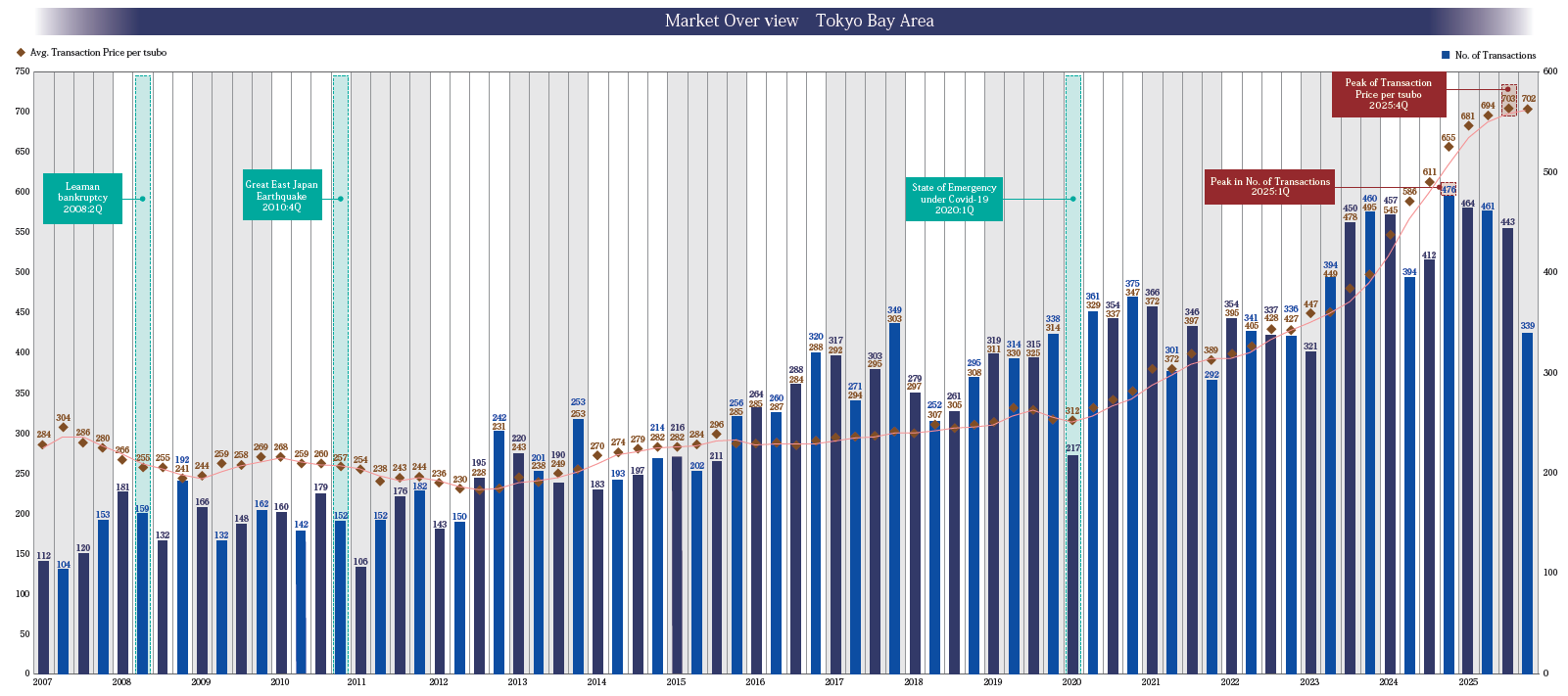
We define the following nine submarkets as Tokyo's Bay Area: Shibaura, Shinagawa/Konan, Ariake/Odaiba, Shinonome, Harumi, Tsukishima, Toyosu, Kachidoki, and Shiodome/Hamamatsucho. We continuously monitor and analyze market trends across these areas.
Looking at the overall performance of Tokyo's Bay Area during the current quarter (January–March 2026), the average transaction price per square meter slightly declined from JPY 7.03 million in the previous quarter (October–December 2025) to JPY 7.02 million. This represents 99.8% of the previous quarter's level, indicating that the market has shifted from an upward trend to a generally stable phase.
Meanwhile, the number of transactions decreased significantly, falling from 443 transactions in the previous quarter to 339 transactions. By area, transaction volume declined in Shibaura, Shinagawa/Konan, Ariake/Odaiba, Shinonome, Harumi, Tsukishima, Toyosu, and Kachidoki, while the Shiodome/Hamamatsucho area remained largely unchanged.
Overall, while transaction prices have remained at a high level, their growth has begun to plateau, and the number of completed transactions has declined across most areas. Although high-priced properties continue to dominate the Bay Area market, the decrease in transaction volume suggests a somewhat more cautious market environment. Changes in the supply-demand balance between each submarket will therefore require close monitoring going forward.
Continued monitoring of the future market trends will be necessary.
Furthermore, market conditions varied by submarket during the current quarter compared with the previous quarter. The asking-to-sale price gap narrowed in the Shiodome/Hamamatsucho area to 2.60% (down 3.13 percentage points quarter-on-quarter) and in the Shinagawa/Konan area to 2.59% (down 0.38 points).
In contrast, the gap widened in several areas, including Shibaura, where it increased to 5.41% (up 1.81 points), Kachidoki, where it rose to 4.53% (up 2.66 points), and Harumi, where it reached 2.28% (up 1.05 points). Notably, Kachidoki recorded the largest increase, indicating signs of price adjustment.
Meanwhile, Ariake/Odaiba (2.01%), Toyosu (2.23%), and Harumi (2.28%) continued to maintain relatively low-price gaps, indicating that the difference between asking prices and actual transaction prices remained limited.
Overall, transaction prices across the Bay Area continued to remain close to asking prices, reflecting resilient market conditions despite some variations among submarkets.
Tokyo's Bay Area continues to evolve as one of the city's most desirable districts, not only as a high-quality residential area but also as a hub for cultural and sporting activities, supported by ongoing development and infrastructure improvements.
At the same time, given the area's prominence and strong market attention, the condominium market within Tokyo's Bay Area is expected to continue evolving on a property-by-property basis. Future market conditions are expected to vary from property to property because of changes in social and economic circumstances, infrastructure development plans, and new condominium construction and completion projects.
As a result, careful monitoring of these factors will remain essential when assessing future market trends and individual property performance in the Bay Area.
You can view the properties currently listed by us in Tokyo's Bay Area via the link below .