Our Site uses cookies to improve your experience on our website. For more details, please read our Cookie Policy.
By closing this message or starting to navigate on this website, you agree to our use of cookies.
Our Site uses cookies to improve your experience on our website. For more details, please read our Cookie Policy.
By closing this message or starting to navigate on this website, you agree to our use of cookies.
This page is translated using machine translation. Please note that the content may not be 100% accurate.


Contact
Mitsui Fudosan Realty can provide a wide range of real estate services on both investment and residential properties.
Please feel free to give us a call or contact with mail inquiry.
Phone(English Line)
Contact Information by Region
- China400-120-1319
- HongKong800-93-3060
- Taiwan00801-81-2728
- Japan(English)0120-923-431
- Other Regions+81-3-6758-4072
Contact
Mitsui Fudosan Realty can provide a wide range of real estate services on both investment and residential properties.
Please feel free to give us a call or contact with mail inquiry.
Phone(English Line)
Contact Information by Region
- China400-120-1319
- HongKong800-93-3060
- Taiwan00801-81-2728
- Japan(English)0120-923-431
- Other Regions+81-3-6758-4072
This page is translated using machine translation. Please note that the content may not be 100% accurate.

Investment Real Estate Market Report | 1Q FY2026

Areas subject to collection of data
Tokyo Central submarket: Minato-ku, Chiyoda-ku, Chuo-ku, Shibuya-ku, Shinjuku-ku, and Bunkyo-ku
Tokyo South submarket: Shinagawa-ku, Meguro-ku, Setagaya-ku, and Ota-ku
Tokyo North / West submarket: Suginami-ku, Nakano-ku, Nerima-ku, Toshima-ku, Itabashi-ku, Kita-ku, and Taito-ku
Tokyo East submarket: Koto-ku, Sumida-ku, Arakawa-ku, Edogawa-ku, Katsushika-ku, and Adachi-ku
Yokohama / Kawasaki region: Yokohama city and Kawasaki city
Detailed descriptions
Pick Up Area: For investment real estate, trends in the average gross yields on contract price and initial asking price, together with the number of closed contracts by submarkets are represented in the graph. The details of the transition of actual market value and properties both for sale and sold in certain neighborhoods are also shown.
Market Overview: As an overview of all the submarkets, the trend from the past to this quarter is available. Trends in the average gross yields based on contract price and initial asking price together with the number of closed contracts by area are shown for comparison.
Data Source: Information is extracted from the database containing properties offered for sale and contracts concluded through Mitsui Fudosan Realty Network (En-bloc condominiums / office buildings / apartment buildings).
- Number of Transactions & Average Gross Yield on Contract Price: Number of contracts closed in a quarter (three months) and average gross yield of them (including estimated values)
- Average Gross Yield on Initial Asking Price: Quarterly average gross yield of closed contracts based on their asking price initially quoted
*Figures in each chart represent indices based on values for 1Q / FY2019 set at 100.
(Average Gross Yield on Contract Price is shown as an index to Average Gross Yield on Initial Asking Price for 1Q / FY 2019 set at 100.)
[Note] The historical data may be revised subsequently due to maintenance carried out from time to time, such as adding newly acquired data.
Pick Up Area -Tokyo Central submarket-
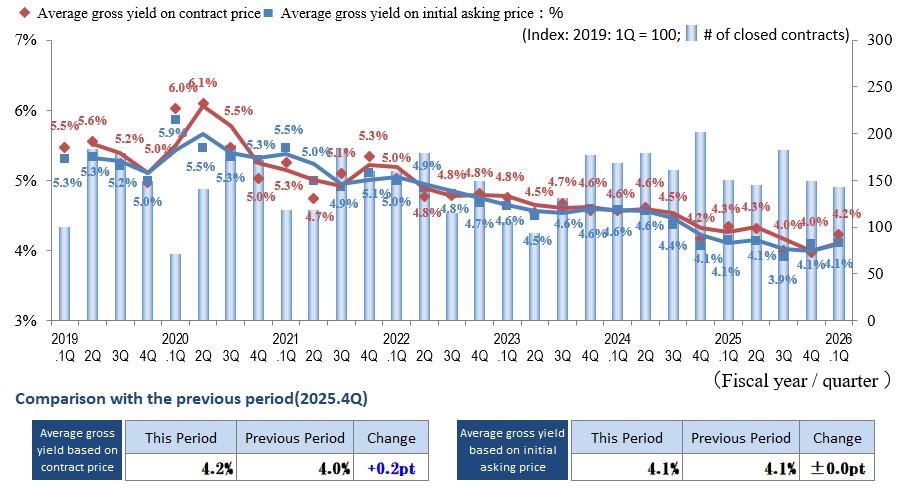
◆Movements by Quarter: Average Gross Yield on Contract Price / Average Gross Yield on Initial Asking Price / Number of Transactions
◆Brokered Transactions of Investment Real Estate in the Submarket
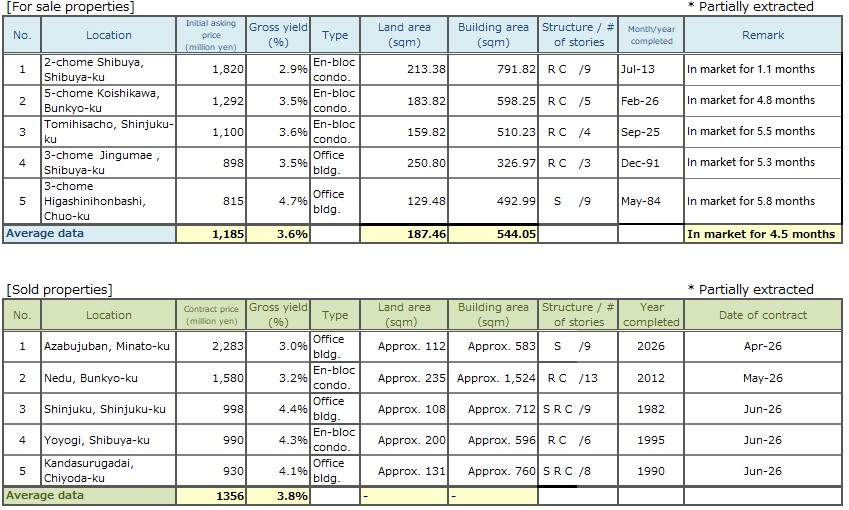
In Tokyo Central submarket, the average asking gross yield in 1Q 2026 remained largely unchanged, while the average transacted gross yield increased by 0.2 percentage points, reflecting a decline in transaction prices. The number of transactions also showed a slight decrease compared with the same period of the previous year..
The leasing market in Central Tokyo is summarized as follows:
■ Residential: The market continues to perform steadily, with rents maintaining a gradual upward trend.
■ Office:Strong demand continues, driven by companies seeking to improve office environments and locations to enhance talent acquisition and retention. As supply remains limited, particularly for large-scale office buildings, vacancy rates continue to decline while rental rates maintain an upward trajectory.
■ Retail: Although the number of inbound visitors to Japan has shown signs of decline and inbound consumption has moderated, spending by affluent domestic consumers remains robust, supported in part by strong equity markets. Rents for highly visible retail properties, such as street-front stores in prime luxury retail districts, continue to rise; however, the pace of rental growth has begun to moderate.
As outlined above, leasing market conditions across the major asset classes generally remain favorable. However, rental growth is showing signs of slowing. Concerns that had been present in previous periods, including rising interest rates and increasing maintenance and repair costs resulting from higher construction material prices and labor costs, are becoming more apparent.
For income-producing properties, further increases in holding costs appear unavoidable. In order to maintain or improve net yields, landlords will need to achieve rental growth that exceeds the increase in operating and ownership costs. However, amid growing uncertainty regarding future market conditions, a clearer distinction is emerging between properties that are favorably evaluated by the market and those that are not.
We have also seen an increase in consultations from asset owners regarding the impact of rising ownership costs and deteriorating cash flow. If you would like to review the value of your real estate holdings or discuss strategies for maximizing their long-term potential, we would be pleased to assist you. Even if your plans are not yet concrete, please do not hesitate to contact us for an initial consultation.
Pick Up Area -Tokyo South submarket-
(*) Tokyo South submarket: Shinagawa-ku, Meguro-ku, Setagaya-ku, and Ota-ku
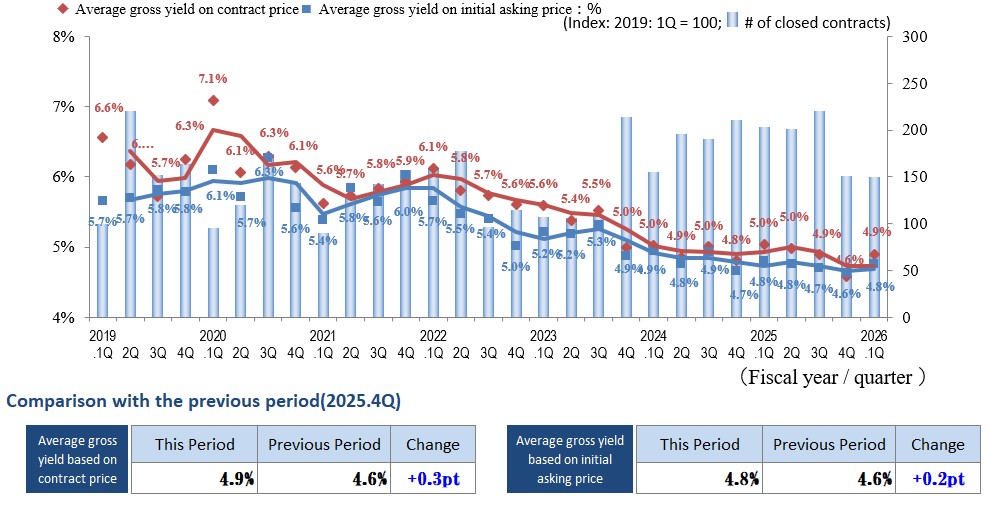
◆Movements by Quarter: Average Gross Yield on Contract Price / Average Gross Yield on Initial Asking Price / Number of Transactions
◆Brokered Transactions of Investment Real Estate in the Submarket
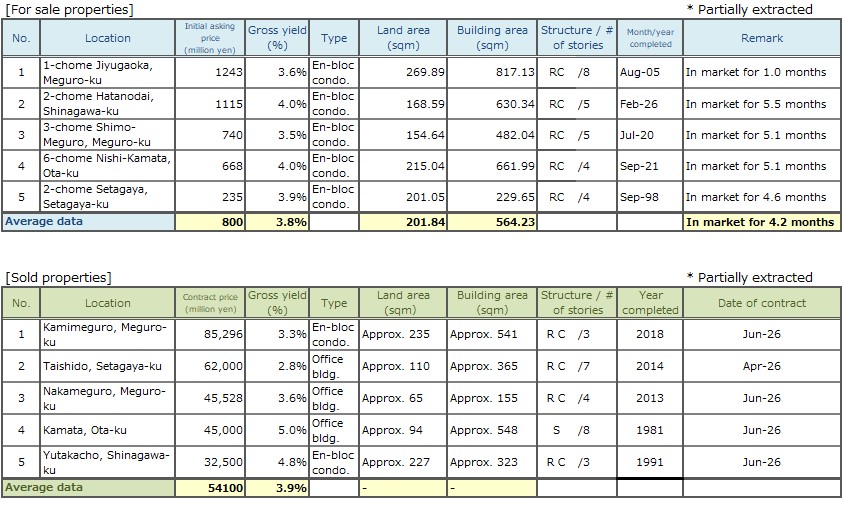
In Tokyo South submarket, the average asking gross yield in 1Q 2026 increased by 0.2 percentage points, while the average transacted gross yield rose by 0.3 percentage points compared with the previous quarter, indicating a decline in pricing. Despite this increase in yields, they remain at historically low levels, and property prices continue to stay near peak levels. Demand for income-producing real estate, particularly in central Tokyo, remains strong, and investors continue to demonstrate an aggressive acquisition stance toward highly scarce and desirable assets.
Transaction volume remained generally stable compared with the previous quarter. In addition, the gap between average asking and transacted gross yields has remained narrow, continuing the trend observed since 2024. Based on transaction data, the investment market in Tokyo South submarket can therefore be characterized as stable and resilient.
Looking ahead, properties in Tokyo South submarket that possess the three key attributes of superior location, high-quality specifications, and long-term growth potential are expected to continue benefiting from solid demand from both domestic and international high-net-worth investors. As a result, transactions involving such assets are likely to remain stable, supported by firm pricing expectations.
At the same time, during 1Q 2026, consultations regarding the ownership, succession, and disposition of real estate increased amid continued attention to monetary policy developments and the possibility of additional interest rate hikes, as well as growing interest in the minimum tax regime. Furthermore, elevated labor costs and persistently high construction material prices continue to drive construction costs upward, remaining a significant concern for market participants.
While demand for high-quality assets in the Jonan area is expected to remain fundamentally strong going forward, investors are becoming increasingly selective in their acquisition strategies. Greater emphasis is being placed on factors such as location, income-generating capability, and long-term asset value, and investment decisions are expected to be driven more heavily by these considerations in the future.
Pick Up Area -Tokyo North / West submarket-
(*) Tokyo North / West submarket: Suginami-ku, Nakano-ku, Nerima-ku, Toshima-ku, Itabashi-ku, Kita-ku, and Taito-ku
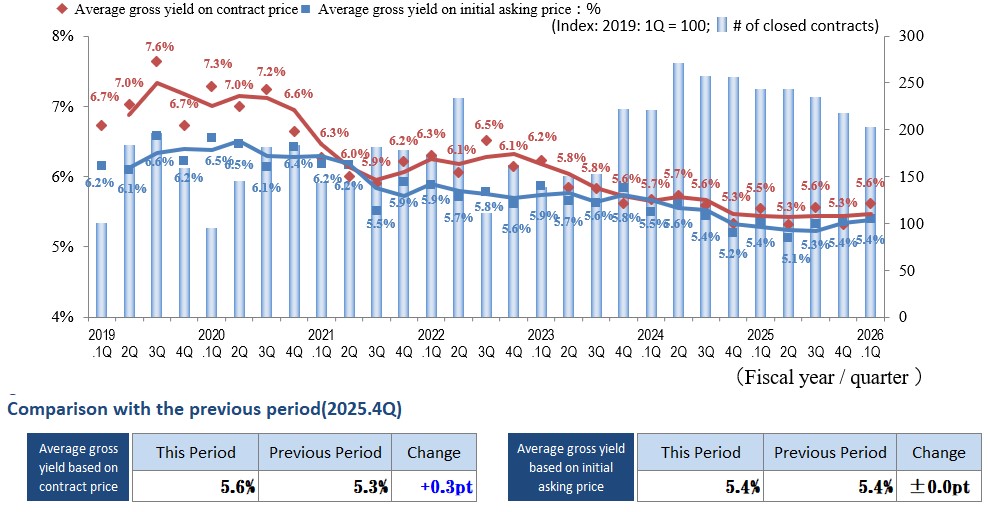
◆Movements by Quarter: Average Gross Yield on Contract Price / Average Gross Yield on Initial Asking Price / Number of Transactions
◆Brokered Transactions of Investment Real Estate in the Submarket
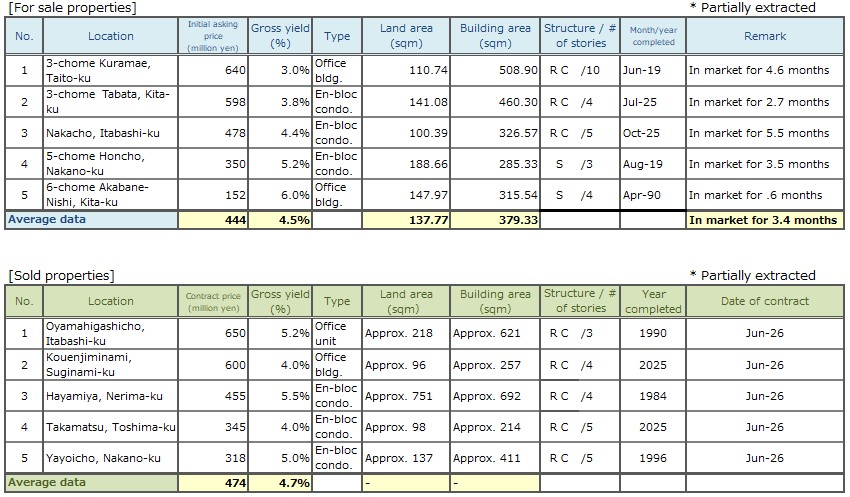
In Tokyo North / West submarket, the investment real estate market in 1Q 2026 recorded an average transacted gross yield of 5.6% (up 0.3 percentage points quarter-on-quarter, reflecting a decline in prices) and an average asking gross yield of 5.4% (unchanged from the previous quarter). Both asking and transaction prices have remained relatively stable over the past year, with no significant fluctuations observed.
Transaction volume has continued its gradual decline since reaching a peak in 2Q 2024, and this trend persisted during the current quarter. This is likely attributable not only to a reduction in the supply of new properties coming to market, but also to an increasing number of assets requiring longer marketing periods before sale, resulting in a gradual contraction in overall transaction activity.
Rising interest rates continue to have a significant impact on the real estate market. For investors who rely on financing from financial institutions, deteriorating cash flow resulting from higher borrowing costs has made it increasingly difficult to pursue new real estate investments. In contrast, investors with substantial liquidity continue to actively allocate capital to real estate, maintaining a strong acquisition appetite despite the changing interest rate environment.
Attention has also increasingly turned to property owners considering dispositions. Following the enactment of the FY2026 Tax Reform Act on April 1, 2026, which includes enhanced taxation on large capital gains under the so-called "Minimum Tax" regime, scheduled to take effect on January 1, 2027, market participants have observed a growing number of owners seeking to complete property sales before the end of this year in order to avoid the new tax treatment.
The real estate investment market appears to be experiencing a clearer divergence between investors who continue to pursue investment opportunities proactively and those who prioritize risk mitigation. Under such circumstances, it is increasingly important for investors to continuously monitor changes in market conditions, establish investment strategies aligned with their objectives, and act consistently in accordance with those strategies.
Furthermore, as real estate-related taxation continues to evolve, keeping up to date with regulatory and tax developments has become increasingly important. Seeking advice from experienced real estate professionals can be an effective way to gain the latest insights and ensure that investment and ownership decisions are made based on a thorough understanding of the current market and tax environment.
Pick Up Area -Tokyo East submarket-
(*) Tokyo East submarket: Koto-ku, Sumida-ku, Arakawa-ku, Edogawa-Ku, Katsushika-ku, and Adachi-ku
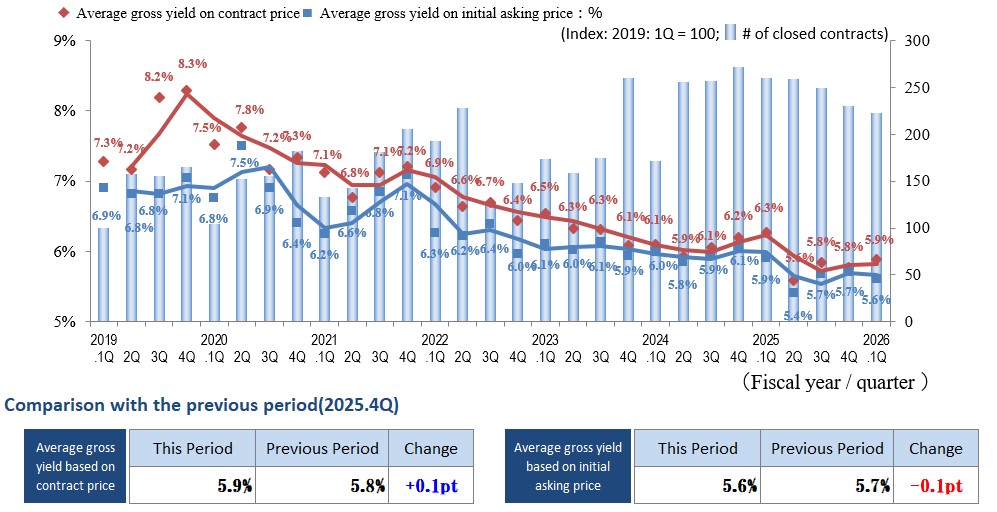
◆Movements by Quarter: Average Gross Yield on Contract Price / Average Gross Yield on Initial Asking Price / Number of Transactions
◆Brokered Transactions of Investment Real Estate in the Submarket
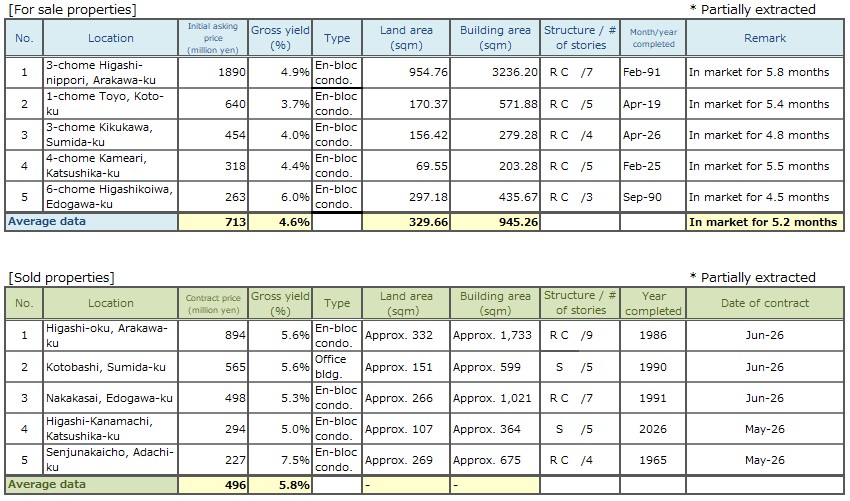
In Tokyo East submarket, the investment real estate market recorded an average transacted gross yield of 5.9% in 1Q 2026, representing an increase of 0.1 percentage points from the previous quarter, while the average asking gross yield stood at 5.6%, down 0.1 percentage points quarter-on-quarter. Although a slight gap remains between asking and transacted yields, the difference is limited and does not suggest any significant change in market conditions or in the overall balance of supply and demand. Transaction volume has been on a gradual decline since 3Q 2025; however, a reasonable level of market activity has been maintained, indicating that the market remains broadly stable.
At the same time, investors have become increasingly selective in their acquisition criteria. Investment decisions are no longer based solely on yield levels, but also on a comprehensive assessment of factors such as rental income, occupancy rates, maintenance and repair history, and the long-term income-generating potential of a property. This trend is likely attributable to the continued rise in financing costs resulting from the higher interest rate environment, as well as persistently elevated construction costs.
Even under these market conditions, properties offering strong fundamentals, such as those located near railway stations, relatively new buildings, and assets situated within major redevelopment districts, continue to attract robust investor interest. Properties benefiting from stable leasing demand and future growth potential are often sold within relatively short marketing periods, despite offering comparatively low yields. Conversely, older properties, assets with less favorable locations, or properties priced significantly above prevailing market levels tend to generate limited buyer interest and often require extended selling periods.
Accordingly, while the overall market continues to demonstrate stability, differences in valuation based on the competitiveness of individual properties have become more apparent than in previous years. Investors are increasingly differentiating between assets, with greater scrutiny being applied during the acquisition process.
Looking ahead, the investment real estate market in the Joto area is expected to remain fundamentally resilient. Nevertheless, close attention should be paid to external factors, including interest rate movements and the trajectory of construction costs. Under such circumstances, demand is expected to remain concentrated on assets that offer appropriate pricing, stable income performance, and sustainable long-term value, and this trend is likely to continue for the foreseeable future.
Pick Up Area -Yokohama / Kawasaki region-
(*) Yokohama and Kawasaki region: Yokohama city, Kawasaki city
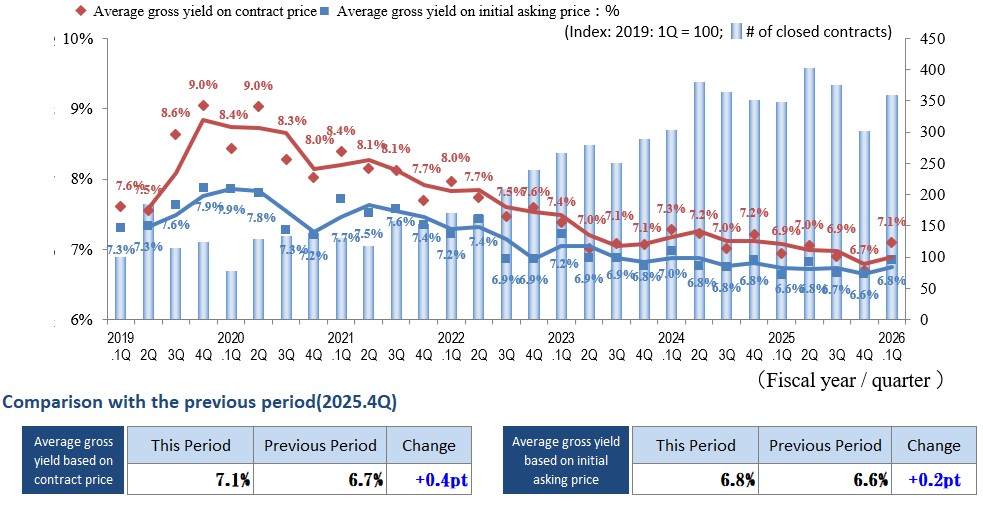
◆Movements by Quarter: Average Gross Yield on Contract Price / Average Gross Yield on Initial Asking Price / Number of Transactions
◆Brokered Transactions of Investment Real Estate in the Submarket
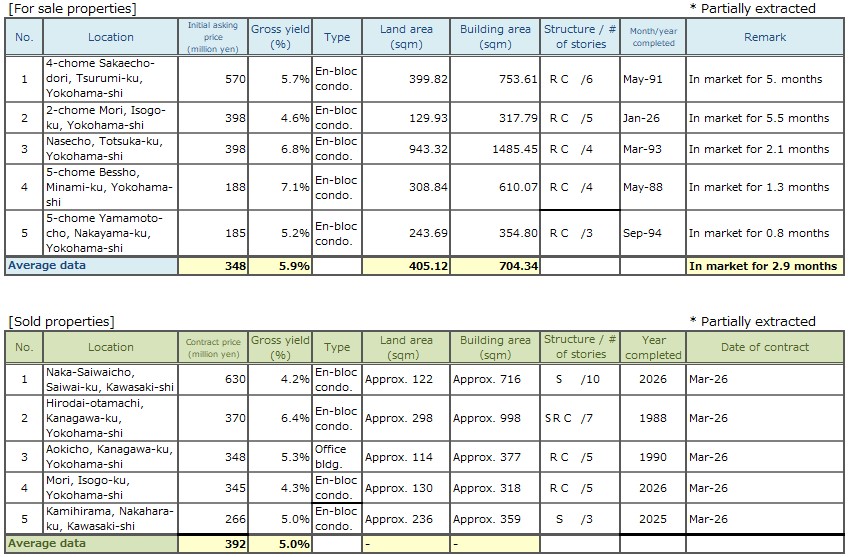
In Yokohama / Kawasaki submarket, both the average transacted gross yield and the average asking gross yield increased in 1Q 2026, reflecting a decline in property prices. Although yields had generally remained flat with a slight downward bias in recent periods, they reversed course from the previous quarter, when yield levels reached their lowest point since data collection began. In particular, the average transacted gross yield rose by 0.4 percentage points, returning to the 7% range.
Transaction volume also increased compared with the previous quarter. While the preceding quarter recorded the lowest number of transactions in the past two years, activity rebounded and the market continued to perform strongly overall. Compared with other areas, transaction volume in Yokohama and Kawasaki remains relatively high. Furthermore, compared with central Tokyo, property prices are lower while higher yields can generally be achieved, making the area an attractive and accessible market for investors.
Although the effects of the Naphtha Shock that emerged in the spring of 2026 have largely subsided, construction costs continue to rise significantly. In certain locations and development environments, higher development costs have made it increasingly difficult for developers to undertake new projects. As a result, the supply of newly developed properties may become more constrained, supporting the value of relatively new, well-maintained existing properties and contributing to firmer pricing for such assets.
At the same time, rising interest rates have increased the return expectations of investors. Consequently, properties that are unable to achieve rental growth may become less attractive investment opportunities going forward. In this environment, the divergence in property performance based on location-related factors, such as proximity to railway stations and the surrounding living environment, is expected to become even more pronounced.
Accordingly, while the overall market remains active and fundamentally healthy, investor attention is increasingly focused on properties that can demonstrate sustainable rental growth and long-term competitiveness. Assets with strong locational advantages and stable demand are expected to continue attracting interest, whereas properties lacking these characteristics may face greater challenges in maintaining pricing and liquidity in the market.
General overview
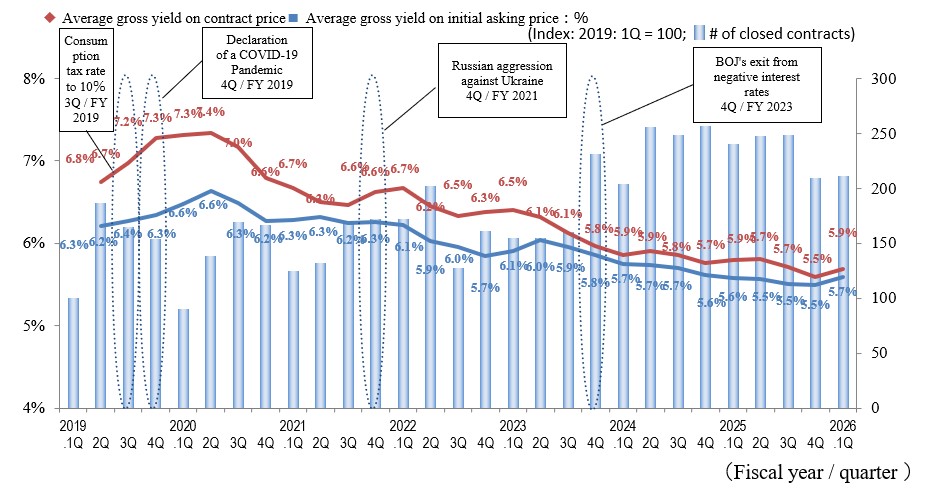
◆Movements by Quarter: Average Gross Yield on Contract Price / Average Gross Yield on Initial Asking Price / Number of Transactions for the 5 Areas
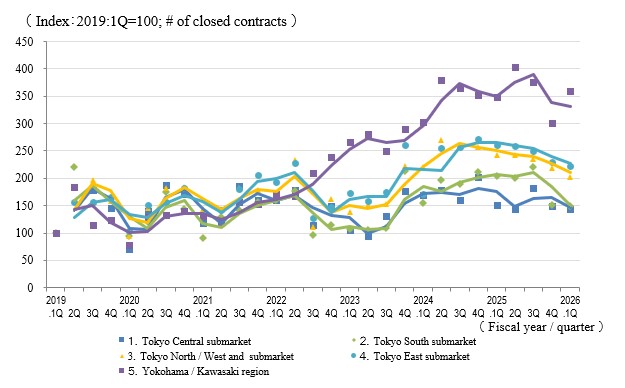
◆Movements in Number of Transactions by Area
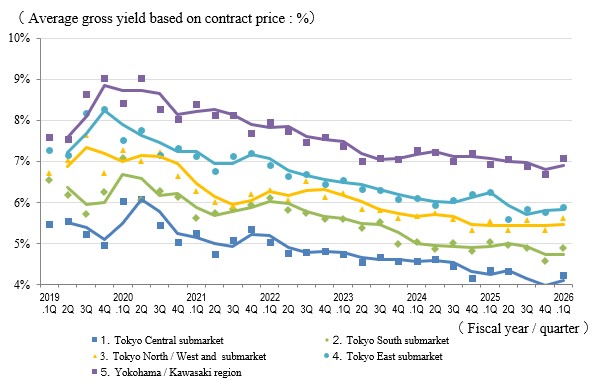
◆Movements in Average Gross Yield on Contract Price by Area
◆Movements in Average Gross Yield on Initial Asking Price by Area
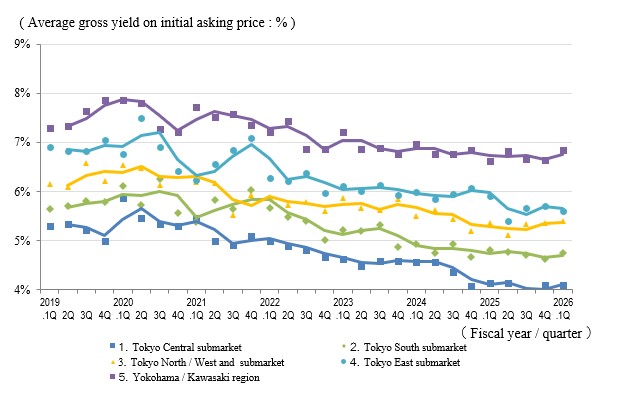
The investment real estate market in 1Q 2026 remained generally resilient, with average yield levels staying broadly stable across most areas. At the same time, transaction volumes varied by region, reflecting increasingly selective acquisition criteria among investors. Strong demand continued for scarce assets located in central Tokyo and highly desirable residential neighborhoods, as well as for properties supported by stable leasing demand. In contrast, properties facing challenges in terms of profitability, location, or competitiveness have experienced longer marketing periods, highlighting the ongoing polarization of the market.
From a macroeconomic perspective, the real estate market continues to be affected by external factors, including upward pressure on interest rates arising from the Bank of Japan's monetary policy direction and expectations of further rate hikes. In addition, persistently high prices for construction materials and elevated labor costs continue to drive construction costs higher, creating challenges across the broader real estate sector.
Furthermore, growing attention surrounding the so-called “Minimum Tax” regime, which is scheduled to take effect in January 2027, has led to an increase in consultations related to asset succession planning and property dispositions. Against this backdrop, market participants are placing greater emphasis not only on headline yields but also on a comprehensive evaluation of investment fundamentals, including net profitability, potential for future rental growth, and the risk of rising holding and operating costs.
Looking ahead, demand for properties with superior locations and strong competitive advantages is expected to remain fundamentally solid. However, investors are becoming increasingly discerning, and assets that can demonstrate sustainable income generation, long-term value preservation, and resilience against changing market conditions are likely to be favored.
At Mitsui Fudosan Realty’s Solutions Business Division, we are committed to providing timely market insights and strategic advice that accurately reflect evolving market conditions. By working closely with each client and understanding their individual investment objectives, we offer a comprehensive range of real estate solutions, including acquisition and disposition support, asset enhancement strategies, and succession planning.
Should you have any questions regarding investment real estate or wish to discuss your real estate portfolio, please do not hesitate to contact us. We would be pleased to assist you in identifying opportunities and developing strategies tailored to your long-term objectives.